Published 20 avril 2026Updated 6 juillet 2026
Vous pouvez créer une page carrières sans ATS lorsque le problème urgent est l'expérience candidat publique, pas la gestion interne du pipeline. L'objectif est de bâtir un hub de recrutement crédible, de le relier à des pages de poste plus riches, de recueillir ou router l'intérêt des candidats, et de garder une configuration assez flexible pour fonctionner avec un ATS plus tard. Si vous voulez poser les bases, commencez par ce qu'est une page carrières.
La réponse courte
Une page carrières sans ATS fonctionne lorsque vous avez besoin d'une couche candidat : une page à votre image pour vos postes ouverts, des pages de poste plus riches derrière chaque opportunité, et un moyen simple de recueillir l'intérêt ou d'envoyer les candidats vers un autre processus. Ce n'est pas un remplacement des fonctions ATS avancées comme la gestion complète du pipeline, les grilles d'évaluation, les validations ou les rapports de conformité.
Peut-on créer une page carrières sans ATS ?
Oui. Une page carrières n'a pas besoin de commencer dans un ATS.
Au niveau le plus simple, il vous faut quatre éléments :
- une page publique qui explique qui recrute
- une liste claire des postes ouverts
- des pages de poste qui donnent assez de contexte aux candidats pour décider s'ils veulent continuer
- un moyen pour les candidats intéressés de postuler, partager leurs informations, déposer un CV ou entrer dans un autre processus
Cette approche peut suffire à des équipes resserrées, des fondateurs, des cabinets spécialisés ou des entreprises en croissance qui veulent une présence recrutement plus crédible avant d'acheter, remplacer ou reconstruire un ATS complet.
La distinction importante est le périmètre. La page carrières est la couche visible par le candidat. L'ATS est généralement le système interne de référence. Vous pouvez améliorer la première sans vous engager immédiatement dans le second.
Quand une page carrières sans ATS a du sens
Cette approche est pertinente lorsque votre expérience recrutement visible est le principal blocage.
- votre entreprise a besoin rapidement d'un hub de recrutement crédible
- vos offres actuelles semblent trop fines, génériques ou déconnectées de votre marque employeur
- vous n'avez que quelques postes actifs et pas encore besoin d'un pipeline complexe
- vous voulez garder vos outils de recrutement actuels tout en améliorant le parcours candidat public
- vous avez besoin de meilleures pages de poste pour le sourcing, les recommandations, les campagnes payantes ou le trafic entrant
C'est une décision de séquence. L'équipe ne dit pas qu'un ATS n'a aucune valeur. Elle dit que la première chose vue par les candidats doit être améliorée maintenant.
Pour une page carrières de petite entreprise, la première version doit rester pratique : des rôles clairs, un contexte d'entreprise crédible et une prochaine étape compréhensible sans processus recrutement lourd derrière.
Quand vous avez encore besoin d'un ATS complet
Une page carrières légère ne suffit pas lorsque le problème principal est la profondeur opérationnelle.
Vous avez probablement besoin d'un ATS complet, ou devez continuer à utiliser votre ATS actuel, si vous avez besoin de :
- gestion de pipeline en plusieurs étapes
- grilles d'entretien structurées
- flux de validation
- permissions des responsables du recrutement et contrôles de processus
- rapports de conformité
- analyse avancée des sources candidat sur tout le parcours
- opérations de recrutement à fort volume avec de nombreux intervenants
Dans ces cas, la page carrières doit travailler avec l'ATS. La page publique aide les candidats à comprendre l'entreprise et le poste. L'ATS gère le processus interne une fois le candidat entré dans le processus.
Page carrières, ATS ou site web sur mesure
Le mauvais choix vient souvent du fait que tous les problèmes de pages recrutement sont traités comme le même problème. Une page carrières faible, un processus ATS faible et un site d'entreprise faible sont trois sujets différents.
| Option | Idéal pour | Compromis |
|---|---|---|
| Configuration légère de page carrières | Améliorer rapidement la couche candidat avec un hub de marque et des pages de poste plus fortes. | Ne remplace pas les processus ATS avancés, les rapports ou les fonctions de conformité. |
| ATS complet | Gérer les candidatures, les étapes de pipeline, le processus d'entretien structuré et les opérations internes. | Peut être plus lourd à mettre en place si votre premier problème est seulement la qualité de la page publique. |
| Site web sur mesure | Équipes qui veulent un contrôle total du design et disposent d'un support engineering ou agence. | Plus lent à lancer et plus difficile à mettre à jour sans aide pour l'équipe recrutement. |
Pour beaucoup d'équipes, la démarche la plus pragmatique consiste à corriger d'abord la surface recrutement publique, puis à la connecter au reste du processus. Pour voir comment structurer des pages de recrutement plus fortes, consultez ces exemples de pages carrières.
Ce qu'une page carrières sans ATS doit inclure
Même légère, la configuration doit sembler volontaire. Une page qui dit seulement "nous recrutons" et liste quelques postes est rarement assez forte.
- Présentation de l'entreprise ou de l'équipe : assez de contexte pour comprendre qui recrute.
- Postes ouverts : une liste claire des opportunités actuelles.
- Pages de poste : des pages plus détaillées pour chaque opportunité, pas seulement des annonces d'une ligne.
- Chemin de candidature : formulaire, dépôt de CV, e-mail, lien ATS externe ou routage par webhook.
- Marque : visuels, couleurs, domaine et texte cohérents avec l'entreprise.
- Mesure : assez de métriques pour savoir si les candidats visitent, interagissent, manifestent leur intérêt ou décrochent.
Le but n'est pas de créer plus de contenu pour le plaisir. Le but est d'aider les candidats à décider si l'opportunité mérite leur temps.
Comment recueillir des candidatures sans ATS complet
Le chemin de candidature est l'endroit où beaucoup de pages carrières sans ATS échouent. Publier des postes est simple. Gérer clairement l'intérêt candidat est la partie importante.
Choisir un chemin adapté au parcours candidat
Vous avez plusieurs options pratiques :
| Approche | Fonctionnement | Meilleur cas d'usage |
|---|---|---|
| Formulaire et boîte de réception | Les candidats envoient leurs informations via un formulaire et l'équipe reçoit la réponse. | Petites équipes qui veulent un flux de candidature simple. |
| Formulaire et redirection | Les candidats partagent d'abord du contexte, puis passent vers un lien personnalisé comme un outil de planification, un CRM ou une autre étape. | Équipes qui veulent recueillir du contexte avant d'envoyer les candidats ailleurs. |
| Redirection directe | La page envoie les candidats directement vers un lien externe sans recueillir de données d'abord. | Équipes qui ont déjà une destination externe pour les candidatures. |
| Routage par webhook | Les événements candidat sont envoyés vers des outils compatibles webhooks, comme des plateformes d'automatisation, des tableurs, Slack ou un processus ATS compatible. | Équipes qui veulent une automatisation légère sans reconstruire tout leur outillage. |
Garder la prochaine étape évidente
La configuration la plus sûre est celle que les candidats comprennent immédiatement. Ils doivent savoir ce qui se passe lorsqu'ils cliquent sur le CTA principal et quelles informations ils devront partager.
Comment Role.so soutient cette configuration
Pages carrières et Candidate Packs
Role.so est conçu pour la couche candidat du recrutement : Candidate Packs de marque, pages carrières, formulaires, routage et métriques de performance.
Pour une comparaison plus large côté outil, voyez comment les équipes peuvent utiliser un logiciel de page carrières pour les équipes en croissance tout en gardant l'expérience candidat publique séparée des processus ATS plus profonds.
Formulaires, routage et métriques
Avec Role.so, les équipes peuvent :
- créer des Candidate Packs qui fonctionnent comme des pages de poste plus riches
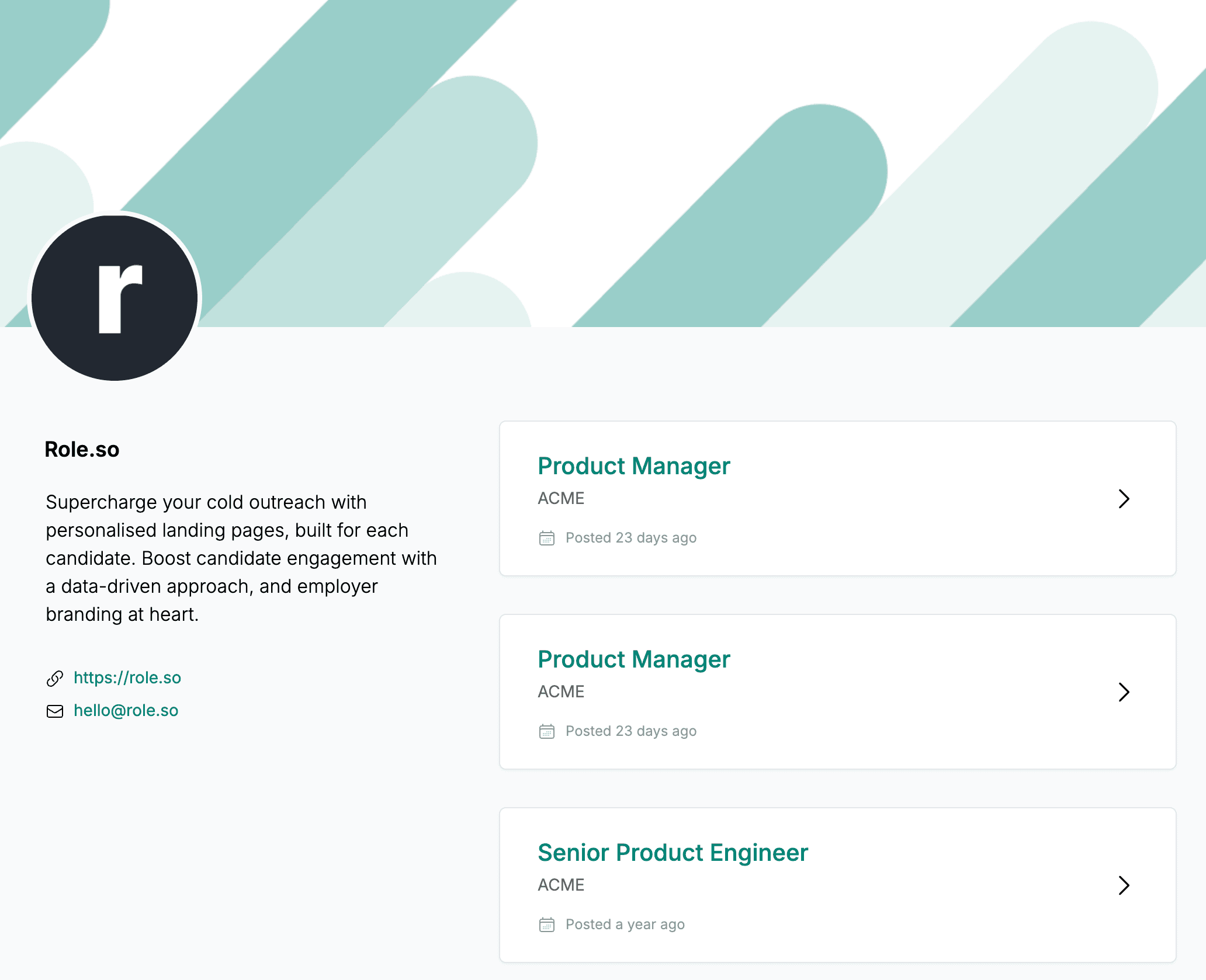
- publier une page carrières qui liste les Candidate Packs publiés
- personnaliser l'URL de la page carrières, le nom affiché, la description, les liens, l'avatar, l'image d'en-tête, le thème et les couleurs de marque
- utiliser un domaine personnalisé lorsqu'il est configuré
- publier ou dépublier la page carrières depuis le tableau de bord
- recueillir l'intérêt via des formulaires configurables
- ajouter un champ CV ou dépôt de fichier au formulaire d'intérêt
- rediriger les candidats vers un lien personnalisé, y compris des outils de planification ou un système de recrutement externe
- afficher les candidats intéressés dans la vue Candidats
- ajouter des notes internes sur les candidats et marquer des candidats comme favoris
- configurer des notifications e-mail selon le plan et la configuration
- envoyer les événements d'intérêt ou de refus via webhooks vers des outils compatibles
- suivre les métriques des Candidate Packs comme les visiteurs, vues, temps moyen, intérêt, refus, taux de réponse, sources de référence, appareils et Candidate Packs les plus performants
- capturer les raisons de refus pour améliorer le message au fil du temps
Cela rend Role.so utile lorsque vous voulez une meilleure expérience recrutement publique sans prétendre que la page carrières devient tout votre système de recrutement.
Exemple : une équipe resserrée qui recrute trois postes
Imaginez une petite entreprise logicielle qui recrute trois postes : product designer, account executive et backend engineer.
L'équipe n'a pas encore besoin d'un déploiement ATS complexe. Ce dont elle a besoin d'abord, c'est d'une expérience recrutement publique qui ne donne pas l'impression d'être improvisée.
Une bonne configuration légère ressemblerait à ceci :
- une page carrières de marque qui présente l'entreprise
- trois Candidate Packs, un pour chaque poste
- chaque page de poste explique l'équipe, les responsabilités, le processus, les avantages et les FAQ
- un formulaire d'intérêt avec champs de contact et dépôt de CV optionnel
- notifications e-mail ou routage webhook pour les nouveaux signaux d'intérêt
- métriques pour voir quels postes attirent l'attention et où les candidats décrochent
C'est suffisant pour créer une surface recrutement crédible. Si l'équipe a plus tard besoin de profondeur opérationnelle, elle peut garder la couche candidat et connecter les candidats à un processus ATS plus complet.
Que mettre sur la page carrières et sur la page de poste
Une erreur fréquente consiste à vouloir tout mettre sur la page carrières. La page carrières doit orienter les candidats. La page de poste doit convaincre et clarifier.
| Page carrières | Page de poste ou Candidate Pack |
|---|---|
| Vue d'ensemble de l'entreprise ou de l'équipe. | Contexte et attentes spécifiques au poste. |
| Liste des postes ouverts. | Responsabilités, prérequis, avantages, processus d'entretien et FAQ. |
| Liens vers le site web, les profils sociaux ou une adresse de contact. | CTA candidat, formulaire d'intérêt, redirection ou flux de candidature. |
| Marque employeur et cohérence visuelle. | Assez de détail pour qu'un candidat décide si le poste vaut la peine d'être poursuivi. |
Cette séparation garde la page carrières facile à parcourir et donne à chaque poste assez de profondeur pour convertir les candidats sérieux.
Erreurs fréquentes à éviter
La plus grosse erreur est de traiter "sans ATS" comme "sans processus". Même légère, la configuration a besoin d'un chemin clair pour l'intérêt candidat, la responsabilité interne et le suivi.
Évitez ces erreurs :
- lancer une page carrières sans vrai détail derrière les postes listés
- utiliser un CTA générique sans expliquer ce qui se passe ensuite
- envoyer les candidats vers un formulaire qui demande trop d'informations trop tôt
- recueillir des candidatures sans propriétaire clair pour la revue
- prétendre que la page remplace un ATS lorsque l'équipe a encore besoin de processus de niveau ATS
- attendre une migration complète alors que la page publique pourrait déjà être améliorée
Les meilleures pages carrières sans ATS ne sont pas des raccourcis. Ce sont des systèmes ciblés avec un rôle plus étroit : rendre l'expérience recrutement publique claire, alignée avec la marque et facile à activer.
Comment décider si cela suffit à votre équipe
Utilisez un test simple. Si le principal problème recrutement est la qualité visible par les candidats, commencez par la page carrières. Si le problème principal est le contrôle du processus interne, gardez ou choisissez un ATS.
- Les candidats ont-ils aujourd'hui un endroit crédible pour comprendre l'entreprise et les postes ouverts ?
- Chaque poste peut-il expliquer assez de contexte au-delà d'une fiche de poste standard ?
- L'équipe a-t-elle un moyen clair de recueillir, router ou rediriger l'intérêt candidat ?
- L'équipe recrutement peut-elle mettre à jour les pages sans attendre un projet web sur mesure ?
- Une meilleure page publique améliorerait-elle le sourcing, les recommandations, le trafic payant ou les candidatures entrantes dès maintenant ?
Si la réponse est oui, améliorer d'abord la page carrières est rationnel. Si la réponse est non parce que le processus interne est déjà en rupture, la page carrières doit faire partie d'une décision ATS plus large.
Construire d'abord la couche publique, puis connecter le processus
La version la plus forte de cette approche n'est pas anti-ATS. Elle est modulaire.
Commencez par une page carrières de marque et des pages de poste plus fortes. Utilisez formulaires, redirections, notifications e-mail, vue Candidats et webhooks pour gérer l'intérêt candidat. Gardez la configuration assez flexible pour qu'un ATS puisse se placer derrière lorsque l'équipe a besoin d'un contrôle de processus plus profond.
Les candidats bénéficient d'une meilleure expérience maintenant, et l'équipe recrutement évite d'acheter plus de logiciel que ce que le problème immédiat exige.
Pour les équipes prêtes à avancer, l'étape pratique consiste à démarrer un essai gratuit de 7 jours de Role.so et à construire la première version de la page carrières. Si vous voulez d'abord de l'aide sur la configuration, consultez comment ajouter une page carrières, comment personnaliser le flux du formulaire d'intérêt ou comment fonctionnent les webhooks dans Role.so.
Frequently asked questions
Oui. Vous pouvez construire la page carrières publique et les pages de poste séparément d'un ATS complet. Il vous faut quand même un moyen clair de recueillir, router ou rediriger l'intérêt des candidats.
Pas toujours. Un ATS devient utile quand l'équipe a besoin de gérer un pipeline structuré, des validations, des rapports et des contrôles internes. Si l'objectif immédiat est de présenter les postes clairement et de recueillir l'intérêt candidat, vous pouvez commencer sans ATS complet.
Non. Role.so est surtout la couche candidat : pages carrières, Candidate Packs, formulaires, routage et métriques. Les équipes qui ont besoin d'une gestion complète du pipeline interne doivent garder ou choisir un ATS.
Oui. Vous pouvez rediriger les candidats vers un lien de candidature externe, envoyer des événements via webhooks vers des outils compatibles ou utiliser les intégrations disponibles lorsqu'elles sont configurées.
Les candidats peuvent manifester leur intérêt via un formulaire configurable, déposer des fichiers lorsque le champ est activé ou être redirigés vers un lien personnalisé. Le bon chemin dépend de votre processus.
Commencez par les bases : une introduction d'entreprise crédible, des postes ouverts clairs, des pages de poste plus fortes, un CTA précis et une façon propre de router l'intérêt candidat.
Choisissez ou gardez un ATS complet lorsque l'équipe a besoin d'étapes de pipeline structurées, de grilles d'évaluation, de validations, de rapports de conformité ou de contrôles de processus plus profonds.