Published 20 april 2026Updated 6 juli 2026
Je kunt een werken-bij-pagina maken zonder ATS wanneer het urgente probleem de publieke kandidaatervaring is, niet het interne pipelinebeheer. Het doel is om een geloofwaardige wervingshub te bouwen, die te verbinden met sterkere vacaturepagina's, kandidaatinteresse te verzamelen of door te sturen en de opzet flexibel genoeg te houden om later met een ATS te werken. Als je eerst de basis nodig hebt, begin dan met wat een werken-bij-pagina is.
Het korte antwoord
Een werken-bij-pagina zonder ATS werkt wanneer je een kandidaatgerichte laag nodig hebt: een pagina in je eigen merkstijl voor open rollen, rijkere vacaturepagina's achter elke rol en een eenvoudige manier om interesse te verzamelen of kandidaten naar een ander proces te sturen. Het is geen vervanging voor diepe ATS-functionaliteit zoals volledig pipelinebeheer, evaluatieformulieren, goedkeuringen of compliancerapportage.
Kun je een werken-bij-pagina maken zonder ATS?
Ja. Een werken-bij-pagina hoeft niet in een ATS te beginnen.
In de eenvoudigste vorm heb je vier dingen nodig:
- een publieke pagina die uitlegt wie er werft
- een duidelijke lijst met open rollen
- vacaturepagina's die kandidaten genoeg context geven om te beslissen of ze verder willen
- een manier waarop geïnteresseerde kandidaten kunnen reageren, gegevens delen, een cv uploaden of naar een ander proces gaan
Die opzet kan genoeg zijn voor kleine teams, oprichters, gespecialiseerde bureaus of groeiende bedrijven die hun publieke wervingsaanwezigheid willen verbeteren voordat ze een volledig ATS kopen, vervangen of opnieuw opbouwen.
Het belangrijke onderscheid is reikwijdte. De werken-bij-pagina is de kandidaatgerichte laag. Een ATS is meestal het interne registratiesysteem. Je kunt de eerste verbeteren zonder meteen vast te zitten aan de tweede.
Wanneer een werken-bij-pagina zonder ATS logisch is
Deze aanpak is het sterkst wanneer je zichtbare kandidaatervaring het knelpunt is.
- je bedrijf snel een geloofwaardige wervingshub nodig heeft
- je huidige vacatures dun, generiek of los van je werkgeversmerk voelen
- je maar een paar actieve rollen hebt en nog geen complexe pipeline nodig hebt
- je bestaande wervingstools wilt behouden terwijl je de publieke kandidaatjourney verbetert
- je betere vacaturepagina's nodig hebt voor sourcing, verwijzingen, betaalde campagnes of inkomend verkeer
Dit is een volgordekeuze. Het team zegt niet dat een ATS geen waarde heeft. Het team zegt dat het eerste wat kandidaten zien nu beter moet.
Voor een werken-bij-pagina voor een klein bedrijf moet die eerste versie praktisch blijven: duidelijke rollen, geloofwaardige bedrijfscontext en een directe volgende stap die kandidaten begrijpen zonder zwaar wervingsproces erachter.
Wanneer je nog steeds een volledig ATS nodig hebt
Een lichte werken-bij-pagina is niet genoeg wanneer het belangrijkste probleem operationele diepte is.
Je hebt waarschijnlijk een volledig ATS nodig, of moet je huidige ATS blijven gebruiken, wanneer je behoefte hebt aan:
- pipelinebeheer met meerdere fases
- gestructureerde interviewevaluaties
- goedkeuringsflows
- rechten voor recruitmentmanagers en procescontrole
- compliancerapportage
- geavanceerde sourcerapportage over de hele wervingsfunnel
- werving met hoge volumes en veel betrokkenen
In die gevallen moet de werken-bij-pagina naast het ATS werken. De publieke pagina helpt kandidaten het bedrijf en de rol begrijpen. Het ATS beheert het interne proces nadat een kandidaat het proces binnenkomt.
Werken-bij-paginabouwer vs ATS vs maatwerk website
De verkeerde keuze ontstaat vaak wanneer elk probleem rond wervingspagina's als hetzelfde probleem wordt behandeld. Een zwakke werken-bij-pagina, een zwak ATS-proces en een zwakke bedrijfswebsite zijn verschillende problemen.
| Optie | Beste voor | Nadeel |
|---|---|---|
| Lichte werken-bij-opzet | De kandidaatgerichte laag snel verbeteren met een hub in je eigen merkstijl en sterkere vacaturepagina's. | Vervangt geen geavanceerde ATS-processen, rapportages of compliancefuncties. |
| Volledig ATS | Sollicitaties, pipelinefases, gestructureerde wervingsprocessen en interne wervingsoperaties beheren. | Kan zwaar zijn om te implementeren als je eerste probleem alleen publieke paginakwaliteit is. |
| Maatwerk website | Teams die volledige designcontrole nodig hebben en engineering- of bureau-ondersteuning beschikbaar hebben. | Trager om te lanceren en moeilijker voor wervingsteams om zonder hulp bij te werken. |
Voor veel teams is de praktische stap om eerst de publieke wervingslaag te verbeteren en die daarna te verbinden met de rest van het proces. Wil je zien hoe sterkere vacature- en werken-bij-pagina's kunnen worden opgebouwd, bekijk dan deze voorbeelden van werken-bij-pagina's.
Wat een werken-bij-pagina zonder ATS moet bevatten
Een lichte opzet moet nog steeds bewust aanvoelen. Een pagina die alleen "we zoeken mensen" zegt en een paar vacatures toont, is zelden sterk genoeg.
- Introductie van bedrijf of team: genoeg context om te begrijpen wie er werft.
- Open rollen: een duidelijke lijst met actuele kansen.
- Vacaturepagina's: diepere pagina's voor elke rol, niet alleen vacatures van één regel.
- Sollicitatiepad: formulier, cv-upload, e-mailflow, externe ATS-link of webhook-doorsturing.
- Merkstijl: beelden, kleuren, domein en teksten die consistent voelen met het bedrijf.
- Meting: genoeg statistieken om te begrijpen of kandidaten bezoeken, interactie tonen, interesse aangeven of afhaken.
Het doel is niet meer inhoud maken om de inhoud. Het doel is kandidaten helpen beslissen of de kans hun tijd waard is.
Hoe je sollicitaties verzamelt zonder volledig ATS
Het sollicitatiepad is waar veel werken-bij-pagina's zonder ATS misgaan. Rollen publiceren is makkelijk. Kandidaatinteresse helder afhandelen is het deel dat telt.
Kies een pad dat past bij de kandidaatjourney
Je hebt een paar praktische opties:
| Aanpak | Hoe het werkt | Meest geschikt voor |
|---|---|---|
| Formulier en postvak | Kandidaten sturen gegevens via een formulier en het team ontvangt de reactie. | Kleine teams die een eenvoudige sollicitatieflow willen. |
| Formulier en doorverwijzing | Kandidaten delen eerst context en gaan daarna naar een aangepaste link zoals planning, CRM of een volgende wervingsstap. | Teams die context willen verzamelen voordat ze kandidaten ergens anders heen sturen. |
| Directe doorverwijzing | De pagina stuurt kandidaten rechtstreeks naar een externe link zonder eerst data te verzamelen. | Teams die al een externe sollicitatiebestemming hebben. |
| Webhook-doorsturing | Kandidaatgebeurtenissen worden naar tools gestuurd die webhooks ondersteunen, zoals automatiseringsplatformen, spreadsheets, Slack of een compatibel ATS-proces. | Teams die lichte automatisering willen zonder de hele toolset opnieuw te bouwen. |
Maak de volgende stap vanzelfsprekend
De veiligste opzet is de opzet die kandidaten direct begrijpen. Ze moeten weten wat er gebeurt wanneer ze op de hoofd-CTA klikken en welke informatie ze moeten delen.
Hoe Role.so deze opzet ondersteunt
Werken-bij-pagina's en candidate packs
Role.so is gebouwd voor de kandidaatgerichte laag van je werving: candidate packs in je eigen merkstijl, werken-bij-pagina's, formulieren, doorsturing en prestatie-inzicht.
Voor een bredere vergelijking op toolniveau kun je zien hoe teams werken-bij-software voor groeiende teams gebruiken, terwijl de publieke kandidaatervaring gescheiden blijft van diepere ATS-processen.
Formulieren, doorsturing en statistieken
Met Role.so kunnen teams:
- candidate packs maken die werken als rijkere vacaturepagina's
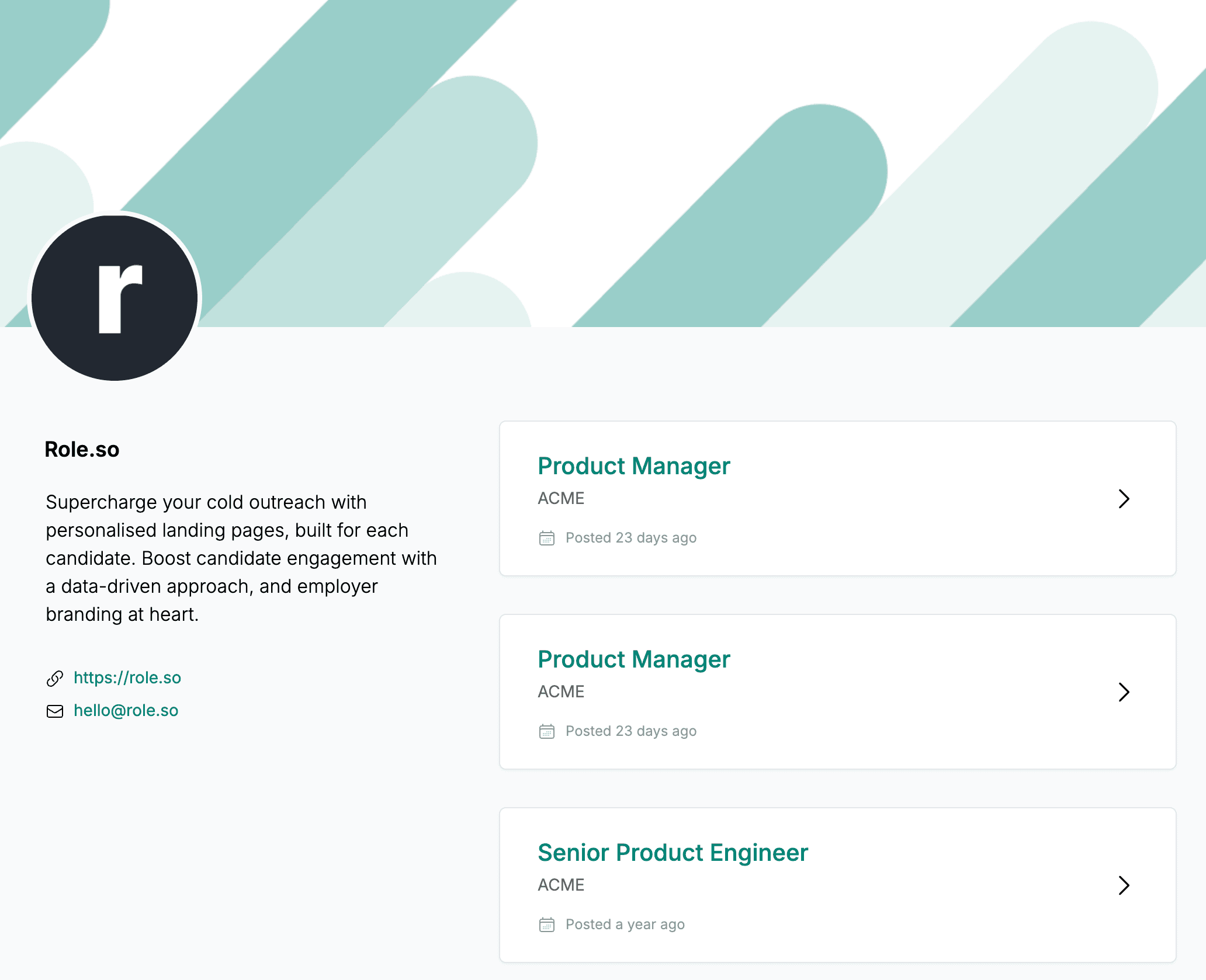
- een werken-bij-pagina publiceren die gepubliceerde candidate packs toont
- de URL, weergavenaam, beschrijving, links, avatar, headerafbeelding, thema en merkkleuren van de werken-bij-pagina aanpassen
- een eigen domein gebruiken wanneer dat is geconfigureerd
- de werken-bij-pagina vanuit het beheerpaneel publiceren of depubliceren
- interesse verzamelen via configureerbare formulieren
- een cv- of file-uploadveld toevoegen aan het interesseformulier
- kandidaten doorsturen naar een aangepaste link, inclusief planningstools of een extern recruitmentsysteem
- geïnteresseerde kandidaten tonen in het kandidatenoverzicht
- interne kandidaatnotities toevoegen en kandidaten als favoriet markeren
- e-mailnotificaties configureren, afhankelijk van plan en opzet
- interesse- of afwijssignalen via webhooks naar compatibele tools sturen
- candidate-packstatistieken volgen zoals bezoekers, weergaven, gemiddelde tijd, interesse, afwijzingen, responspercentage, verwijzende bronnen, apparaten en best presterende candidate packs
- afwijsredenen vastleggen zodat het team de boodschap na verloop van tijd kan verbeteren
Dat maakt Role.so nuttig wanneer je een sterkere publieke kandidaatervaring wilt zonder te doen alsof de werken-bij-pagina je volledige wervingssysteem is.
Voorbeeld: een klein team dat drie rollen werft
Stel je een klein softwarebedrijf voor dat drie rollen werft: product designer, account executive en backend engineer.
Het team heeft nog geen complexe ATS-invoering nodig. Wat het eerst nodig heeft, is een publieke kandidaatervaring die niet geïmproviseerd voelt.
Een sterke lichte opzet ziet er zo uit:
- één werken-bij-pagina in je eigen merkstijl die het bedrijf introduceert
- drie candidate packs, één voor elke rol
- elke vacaturepagina legt het team, verantwoordelijkheden, proces, secundaire arbeidsvoorwaarden en FAQs uit
- een interesseformulier met contactvelden en optionele cv-upload
- e-mailnotificaties of webhook-doorsturing voor nieuwe kandidaatinteresse
- statistieken om te zien welke rollen aandacht krijgen en waar kandidaten afhaken
Dat is genoeg om een geloofwaardige wervingslaag te creëren. Als het team later meer procesdiepte nodig heeft, kan het de kandidaatgerichte laag behouden en kandidaten verbinden met een voller ATS-proces.
Wat hoort op de werken-bij-pagina en wat op de vacaturepagina
Een veelgemaakte fout is proberen om de werken-bij-pagina alles te laten doen. De werken-bij-pagina moet kandidaten oriënteren. De vacaturepagina moet overtuigen en verduidelijken.
| Werken-bij-pagina | Vacaturepagina of candidate pack |
|---|---|
| Overzicht van bedrijf of team. | Specifieke rolcontext en verwachtingen. |
| Lijst met open rollen. | Verantwoordelijkheden, eisen, secundaire arbeidsvoorwaarden, interviewproces en FAQs. |
| Links naar website, social profielen of contactmail. | Kandidaat-CTA, interesseformulier, doorverwijzing of sollicitatieflow. |
| Werkgeversmerk en visuele consistentie. | Genoeg detail zodat een kandidaat kan beslissen of de rol de moeite waard is. |
Deze splitsing houdt de werken-bij-pagina makkelijk scanbaar en geeft elke rol genoeg diepte om serieuze kandidaten te converteren.
Veelgemaakte fouten vermijden
De grootste fout is "zonder ATS" behandelen als "zonder proces". Ook een lichte opzet heeft een duidelijk pad nodig voor kandidaatinteresse, een duidelijke eigenaar en opvolging.
Vermijd deze fouten:
- een werken-bij-pagina lanceren zonder echte roldetails achter de vacatures
- een generieke CTA gebruiken zonder uit te leggen wat er daarna gebeurt
- kandidaten naar een formulier sturen dat te vroeg te veel vraagt
- sollicitaties verzamelen zonder duidelijke eigenaar voor review
- claimen dat de pagina een ATS vervangt terwijl het team nog procescontrole op ATS-niveau nodig heeft
- wachten op een volledige systeemmigratie terwijl de publieke pagina nu al verbeterd kan worden
De beste werken-bij-pagina's zonder ATS zijn geen sluiproutes. Het zijn gefocuste systemen met een smallere taak: de publieke kandidaatervaring helder, merkgericht en actiegericht maken.
Hoe je beslist of dit genoeg is voor je team
Gebruik een simpele test. Als het grootste wervingsprobleem kandidaatgerichte kwaliteit is, begin dan met de werken-bij-pagina. Als het grootste probleem interne procescontrole is, behoud of kies een ATS.
- Hebben kandidaten nu een geloofwaardige plek om het bedrijf en open rollen te begrijpen?
- Kan elke rol genoeg context uitleggen voorbij een standaard vacaturetekst?
- Heeft het team een duidelijke manier om kandidaatinteresse te verzamelen, door te sturen of door te verwijzen?
- Kan het wervingsteam pagina's bijwerken zonder te wachten op een maatwerk webproject?
- Zou een sterkere publieke pagina sourcing, verwijzingen, betaald verkeer of inkomende sollicitaties nu verbeteren?
Als het antwoord ja is, is eerst de werken-bij-pagina verbeteren een rationele stap. Als het antwoord nee is omdat het interne proces al breekt, moet de werken-bij-pagina onderdeel zijn van een bredere ATS-beslissing.
Bouw eerst de publieke laag en verbind daarna het proces
De sterkste versie van deze aanpak is niet anti-ATS. Hij is modulair.
Begin met een werken-bij-pagina in je eigen merkstijl en sterkere vacaturepagina's. Gebruik formulieren, doorverwijzingen, e-mailnotificaties, het kandidatenoverzicht en webhooks om kandidaatinteresse af te handelen. Houd de opzet flexibel genoeg zodat een ATS erachter kan zitten wanneer het team diepere procescontrole nodig heeft.
Dat geeft kandidaten nu een betere ervaring en voorkomt dat het wervingsteam meer software koopt dan het directe probleem vraagt.
Voor teams die willen starten, is de praktische volgende stap om een gratis proefperiode van 7 dagen met Role.so te starten en de eerste versie van de werken-bij-pagina te bouwen. Wil je eerst configuratiehulp, bekijk dan hoe je een werken-bij-pagina toevoegt, hoe je de flow van het interesseformulier aanpast of hoe webhooks in Role.so werken.
Frequently asked questions
Ja. Je kunt de publieke werken-bij-pagina en vacaturepagina's los van een volledig ATS bouwen. Je hebt nog steeds een duidelijke manier nodig om kandidaatinteresse te verzamelen, door te sturen of door te verwijzen.
Niet altijd. Je hebt een ATS nodig wanneer het team gestructureerd pipelinebeheer, goedkeuringen, rapportage en interne procescontrole nodig heeft. Als het directe doel een duidelijkere publieke pagina en betere vacaturepagina's is, kun je zonder volledig ATS beginnen.
Nee. Role.so is het best te begrijpen als de kandidaatgerichte laag: werken-bij-pagina's, candidate packs, formulieren, doorsturing en statistieken. Teams die volledig intern pipelinebeheer nodig hebben, moeten een ATS behouden of kiezen.
Ja. Je kunt kandidaten doorverwijzen naar een externe sollicitatielink, gebeurtenissen via webhooks sturen naar compatibele tools of beschikbare integraties gebruiken wanneer die zijn geconfigureerd.
Kandidaten kunnen interesse indienen via een configureerbaar formulier, bestanden uploaden wanneer het veld is ingeschakeld of worden doorgestuurd naar een aangepaste link. Het juiste pad hangt af van je proces.
Begin met de basis: een geloofwaardige bedrijfsintro, duidelijke open rollen, sterkere vacaturepagina's, een specifieke CTA en een nette manier om kandidaatinteresse door te sturen.
Kies of behoud een volledig ATS wanneer het team gestructureerde pipelinefases, evaluatieformulieren, goedkeuringen, compliancerapportage of diepere procescontrole nodig heeft.